


What happens to security when the weather changes?
How changing weather patterns can create unexpected security risks, disrupt operations and expose gaps in organisational resilience.
How changing weather patterns can create unexpected security risks, disrupt operations and expose gaps in organisational resilience.

How misinformation and uncertainty can affect crisis decision-making and why organisations should test information resilience in crisis exercises.

A convincing LinkedIn profile and a few mutual connections can make a stranger seem legitimate. Katie Barnett looks at how fake recruiter profiles can be used to build trust, gather information and create the groundwork for more targeted attacks.
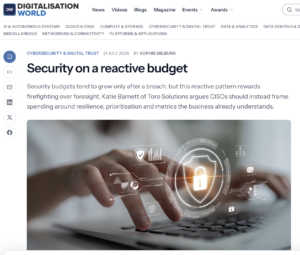
Security budgets often increase after something has gone wrong. Katie Barnett looks at how CISOs can move away from reactive spending by making the case for security in terms the wider business already understands, from resilience and prioritisation to deals, downtime and risk.

Why do security budgets increase after an incident? Learn how to prioritise security investment, demonstrate value and build a stronger business case.

Discover the biggest security risks facing financial institutions in 2026, including AI threats, insider risk, supply chain vulnerabilities and resilience challenges.
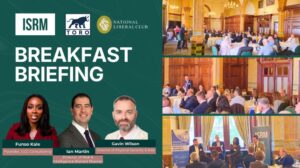
Senior risk, resilience and security leaders gathered at the National Liberal Club to discuss what organisational resilience looks like in practice, covering decision-making under pressure, governance, recovery planning, supply chain vulnerabilities, AI, culture and crisis preparedness.
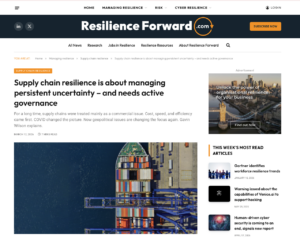
In this piece, Gavin Wilson argues that supply chains can no longer be treated as purely commercial functions but must be managed as core risk systems. With geopolitical tension, regulation, climate disruption and hidden dependencies all shaping outcomes, disruption is now constant rather than exceptional. He highlights how many organisations remain exposed due to limited visibility and fragmented ownership, often reacting only once issues arise. His focus is on active governance, deeper supplier insight and earlier involvement of risk functions, ensuring resilience is built in before disruption hits rather than after.

Our second converged security session hosted in partnership with Mitie brought together senior leaders from security, risk and resilience to explore a practical question: what does convergence look like when it works and why does it remain so difficult to achieve? The session was designed to focus on practice rather than theory. Each panellist was asked to share an example of where convergence is

Why supply chains must be treated as risk systems. Explore geopolitical risk, climate disruption and resilience in modern supply chain governance.

At Toro, business continuity is treated as an operational capability rather than a compliance document.
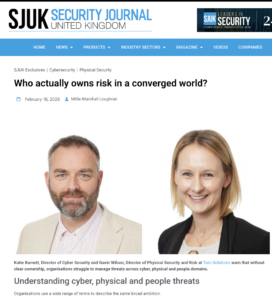
In this article, Katie Barnett, Director of Cyber Security, and Gavin Wilson, Director of Physical Security and Risk at Toro Solutions, warn that many organisations talk about convergence but stop short of true accountability.
While cyber, physical and people risks are increasingly connected, ownership of those risks often remains fragmented. Different teams manage different parts of the picture, with no single leader responsible for how those threats combine. The result is blurred accountability, slow decision-making and gaps that only become visible during an incident.
Barnett and Wilson argue that collaboration alone is not enough. Without clear authority, board-level visibility and a culture that supports joined-up thinking, risk continues to sit between functions rather than being actively managed. Convergence, they conclude, only works when someone is clearly accountable for the whole picture.