Operational Resilience

In this article, Katie Barnett, Director of Cyber Security, and Gavin Wilson, Director of Physical Security and Risk at Toro Solutions, warn that many organisations talk about convergence but stop short of true accountability. While cyber, physical and people risks are increasingly connected, ownership of those risks often remains fragmented. Different teams manage different parts of the picture, with no single leader responsible for how those threats combine. The result is blurred accountability, slow decision-making and gaps that only become visible during an incident. Barnett and Wilson argue that collaboration alone is not enough. Without clear authority, board-level visibility and a culture that supports joined-up thinking, risk continues to sit between functions rather than being actively managed. Convergence, they conclude, only works when someone is clearly accountable for the whole picture.


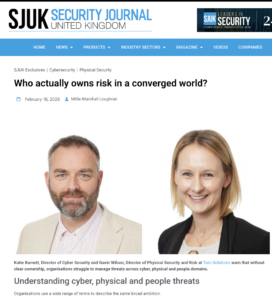
Who actually owns risk in a converged world?

In this article, Katie Barnett, Director of Cyber Security, and Gavin Wilson, Director of Physical Security and Risk at Toro Solutions, warn that many organisations talk about convergence but stop short of true accountability.

While cyber, physical and people risks are increasingly connected, ownership of those risks often remains fragmented. Different teams manage different parts of the picture, with no single leader responsible for how those threats combine. The result is blurred accountability, slow decision-making and gaps that only become visible during an incident.

Barnett and Wilson argue that collaboration alone is not enough. Without clear authority, board-level visibility and a culture that supports joined-up thinking, risk continues to sit between functions rather than being actively managed. Convergence, they conclude, only works when someone is clearly accountable for the whole picture.

Read More »
Cyber Insights 2026: Cyberwar and Rising Nation State Threats

Cyber Insights 2026: Cyberwar and Rising Nation State ThreatsCyber Insights 2026: Cyberwar and Rising Nation State Threats

Peter Connolly, CEO of Toro Solutions, featured in SecurityWeek’s Cyber Insights 2026 report on cyberwar and rising nation state threats.

Quoted alongside global industry leaders, Connolly highlighted one of the biggest challenges facing organisations today: attribution. “Businesses may see the activity, but proving who is behind it often requires classified intelligence and corroboration from other sources that private firms simply do not have access to,” he said, underscoring the uncertainty that shapes response and accountability in an era of blurred lines between criminal and state-backed activity.

The piece explores how cyberwarfare is evolving, why attribution remains complex, and what this means for enterprise resilience in 2026.

Read More »
People not plans

People not plans

In this recent press piece, Toro Solutions’ Directors of Cyber Security and Physical Security and Risk discuss why resilience is about people, not paperwork.

They argue that most organisations don’t fall short because they lack plans, but because their teams operate in silos. When cyber, physical and operational functions fail to share context early, warning signs are missed and response slows down. Convergence, they explain, isn’t about restructuring it’s about getting the right people talking before small issues turn into bigger problems.

Because when pressure hits, it’s not the plan that makes the difference, it’s how well your teams work together.

Read More »
The NCSC Says “It Is Time to Act”, But How?

The NCSC Says “It Is Time to Act”, But How?

One theme runs through the NCSC’s latest Annual Review: resilience isn’t optional anymore and as Peter Connolly, CEO of Toro Solutions, points out, many organisations still haven’t built the foundations they need.

Connolly stresses that frameworks like ISO 27001 aren’t about box ticking. They give leaders a clear, practical way to weave security into everyday business, not just the IT team. “It’s a framework that forces you to look at people, processes and physical security as well as the tech,” he says. “Once that thinking becomes part of daily operations, you’re in a far stronger position when something goes wrong.”

His message fits closely with the government’s call for FTSE 350 boards to take cyber risk seriously: resilience has to be led from the top, and it has to be consistent.

Read the full piece to see how Connolly believes UK organisations can move beyond firefighting and start building the kind of resilience the current threat landscape demands.

Read More »
Converged Resilience

Converged Resilience

A candid discussion on converged resilience – bringing together leaders to share challenges, insights, and practical steps toward a truly integrated approach to security and risk.

Read More »

JLR cyberattack “severely disrupts” production

Jaguar Land Rover (JLR) has been forced to halt production after a major cyberattack “severely disrupted” its operations worldwide. As the carmaker races to restore systems, experts warn the incident underscores the vulnerability of modern, digitised manufacturing.

Katie Barnett, Director of Cybersecurity at Toro Solutions, notes that such events highlight a critical blind spot: supply chain resilience.

“While third-party vendors drive efficiency, businesses must ask: Do partners have the right controls in place? Can infiltration be detected early enough to contain the damage?”

Read the full story to explore how the attack unfolded and what it means for operational technology and supply chain security across the automotive sector.

Read More »

Breaking down silos

Modern attackers don’t just target one area. They target multiple points, looking for a gap.  In most organisations, people work in their own swim lanes so gaps inevitably appear between them. IT focuses on systems, HR on staff, and facilities on physical access. These separate responsibilities inevitably create blind spots. Think about it. IT sees

Read More »