


Security on a reactive budget
Discover why security budgets remain reactive, how CISOs and CIOs can build stronger business cases for investment and practical ways to demonstrate security value beyond breaches.
Discover why security budgets remain reactive, how CISOs and CIOs can build stronger business cases for investment and practical ways to demonstrate security value beyond breaches.
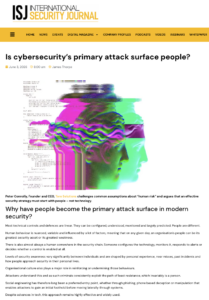
Technology alone cannot stop today’s cyber threats. While organisations continue to invest in advanced security tools, attackers increasingly target the people behind them. In this interview, Peter Connolly, CEO of Toro Solutions, explains why human behaviour has become the primary attack surface in modern security, how criminals exploit trust through social engineering and AI-powered attacks, and why building a culture of resilience is critical to protecting organisations. He also explores the convergence of cyber, physical and human security, and the leadership capabilities needed to stay ahead of an evolving threat landscape.

Before trusting an MSP with privileged access to your systems and data, ask these five essential cyber security questions. Learn how to assess access controls, governance, endpoint security, incident response and supplier risk to make more informed decisions.

From ticket fraud to credential theft, explore how World Cup 2026 scams blur the lines between cyber, physical and people security risks.

Discover how to prepare for Defence Cyber Certification (DCC), the common readiness gaps organisations face and why early preparation can strengthen both compliance and resilience.

Why compliance does not always equal resilience. Explore the gap between security on paper and security in practice and how real attackers exploit operational weaknesses.

Senior risk, resilience and security leaders gathered at the National Liberal Club to discuss what organisational resilience looks like in practice, covering decision-making under pressure, governance, recovery planning, supply chain vulnerabilities, AI, culture and crisis preparedness.
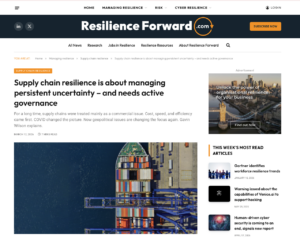
In this piece, Gavin Wilson argues that supply chains can no longer be treated as purely commercial functions but must be managed as core risk systems. With geopolitical tension, regulation, climate disruption and hidden dependencies all shaping outcomes, disruption is now constant rather than exceptional. He highlights how many organisations remain exposed due to limited visibility and fragmented ownership, often reacting only once issues arise. His focus is on active governance, deeper supplier insight and earlier involvement of risk functions, ensuring resilience is built in before disruption hits rather than after.
In this piece, Katie Barnett argues that insider risk is often misunderstood as a problem of malicious intent when in reality it more often develops gradually through stress, fatigue, financial pressure or disengagement. Many incidents are preceded by subtle behavioural changes that go unnoticed or unaddressed, leaving organisations reacting too late. Her focus is on shifting from a purely technical or disciplinary response to one that recognises the role of wellbeing, culture and early intervention. Supporting people earlier, she suggests, is not a soft option but a more effective way to reduce risk before it escalates.
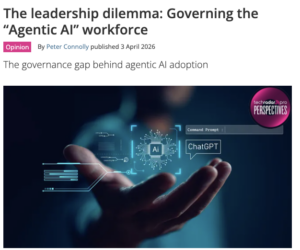
In this piece, Peter Connolly argues that AI is no longer just a tool but an active part of the workforce. As organisations adopt more autonomous, decision-making systems, the real challenge is not deployment but governance. Without clear accountability, identity controls and behavioural guardrails, digital agents can introduce risks similar to highly privileged insiders. His message is straightforward: treat AI like part of the workforce, with defined ownership, oversight and limits, or risk letting autonomy outpace control.
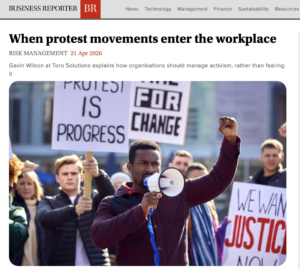
In this piece, Gavin Wilson argues that workplace activism isn’t something organisations should fear but it does need to be managed. Most employee protest is lawful and often healthy but in sensitive environments strong personal convictions combined with access to systems or data can create real risk. Add in the influence of online narratives and external actors and internal tensions can escalate quickly. His focus is on getting the balance right: allowing open disagreement while tightening access, spotting early behavioural changes and making sure concerns are raised early. Ultimately resilience comes down to whether organisations are prepared for when belief, access and pressure collide.

Anthropic’s Mythos highlights a shift in cybersecurity: AI can now find and exploit vulnerabilities at scale. Explore what this means for risk, remediation, and securing AI systems.